Twelve FM algorithms, drawn
An algorithm is just a drawing of who modulates whom. Here are all twelve from Mellt FM-1, and then the trick: the same drawings as pins.
What an algorithm is
An FM synth has a handful of oscillators called operators. Each one can either be heard directly, in which case it's a carrier, or be used to wobble the pitch of another operator thousands of times a second, in which case it's a modulator. A modulator on a carrier adds harmonics. A modulator on a modulator adds harmonics to the harmonics. Stack them and you get brass; fan them out and you get bells.
The map of which operator feeds which is the algorithm. On the famous FM synth of the 1980s there were 32 of them, printed on the lid, chosen by number. Mellt has seven operators and twelve algorithms. More importantly, it has a second way to see them.
The twelve
carrier (you hear it) modulator (you hear its effect) · arrows point from modulator to modulated
Remember that every Mellt operator reads a wavetable, not just a sine. Algorithm 12 with seven different tables is a wavetable synth in its own right. Algorithm 1 with a sawtooth at the top of the stack is something else entirely.
The same thing, as pins
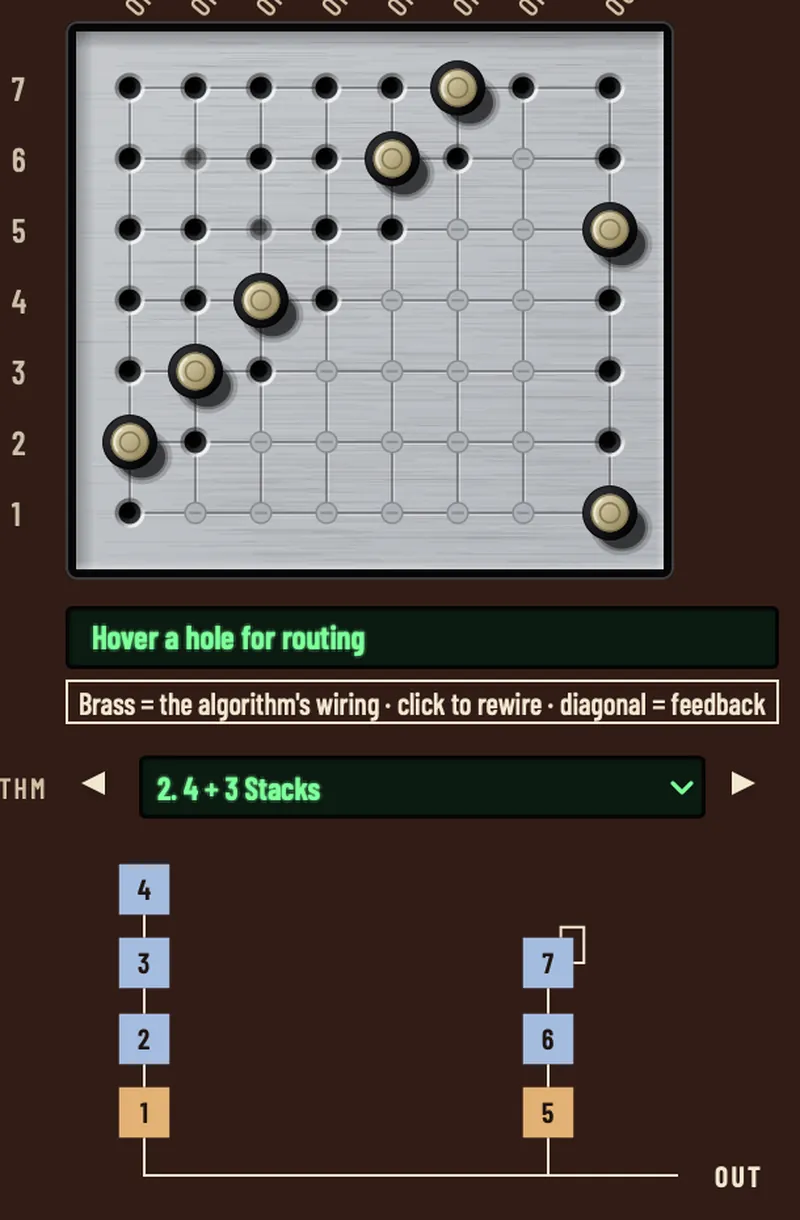
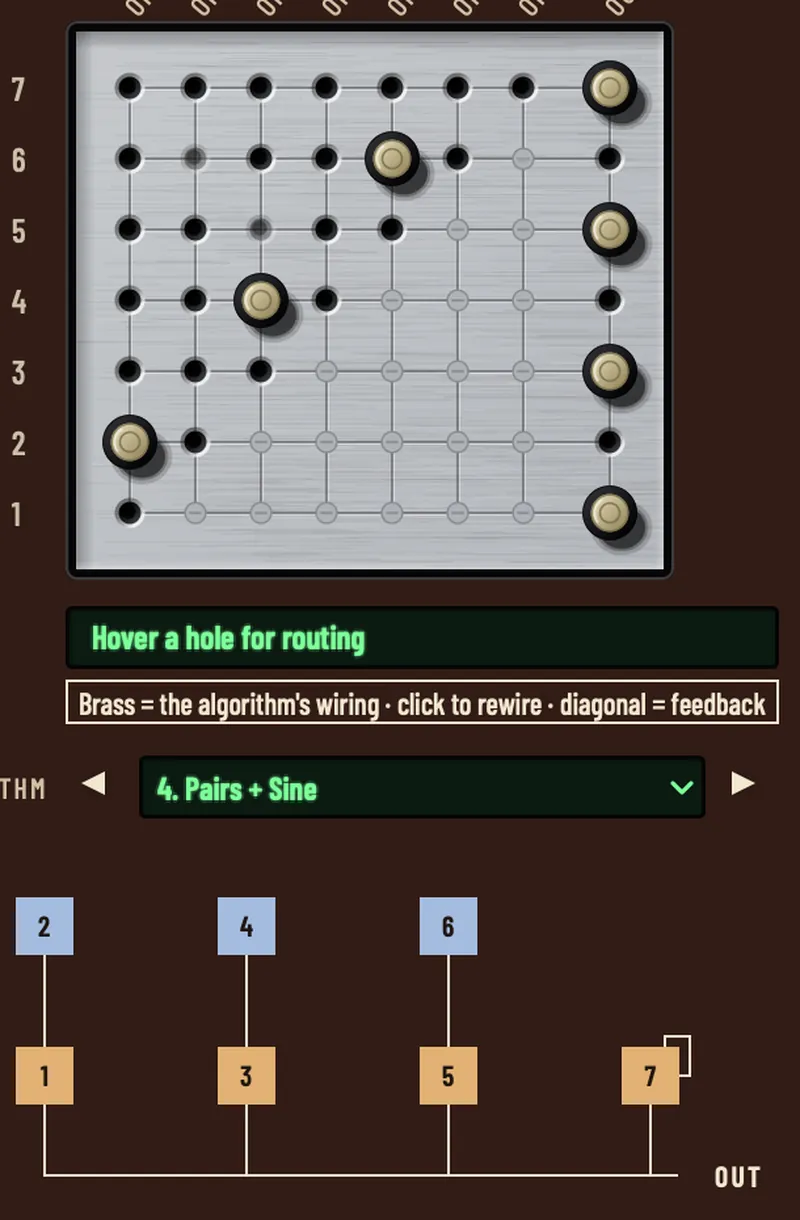
Here's the trick that made us build Mellt. Lay the seven operators down the side as modulators and across the top as modulated, and an algorithm becomes a pattern of pins. The Stack is a diagonal. Six Into One is a column. One Into Six is a row.
Mellt's routing board looks like a patch bay and reads like one, but it is a picker, not a free patch. The twelve algorithms are a fixed list, and the board always shows one of them. What changes is how you choose. Click a connection you want and Mellt jumps to the nearest algorithm that has it. Click one you don't want and it jumps to the nearest that hasn't. You choose by reaching for the sound, not by remembering a number.
- You can read it. A column shows everything feeding one operator. A row shows everywhere one operator goes. The 32-algorithm chart on the lid was a lookup table; this is a map.
- You can choose by connection. Want operator 7 feeding operator 1 directly? Click that pin and you land on One Into Six or Six Into One, whichever is closer to where you were.
- Feedback is a knob, not a pin. No algorithm feeds an operator back into itself or into a higher-numbered one. Instead, every operator has its own feedback control, off by default, and operator 7's is a destination in the modulation matrix, so an envelope can bring feedback in over the course of a note.
A new Mellt opens on algorithm 2, 4 + 3 Stacks. We've found that people familiar with a pin matrix find programming FM far easier to conceptualise this way than through a parameter slider. The famous sounds are all still there: the electric pianos, the bells, the glass. The interface just stops being the reason you never went past the second algorithm.
Patch one.
Mellt FM-1 is free for macOS, as AU, VST3 and Standalone. Pick an algorithm from the diagram, or click the connection you want on the routing board.